
What is OpenClaw AI?
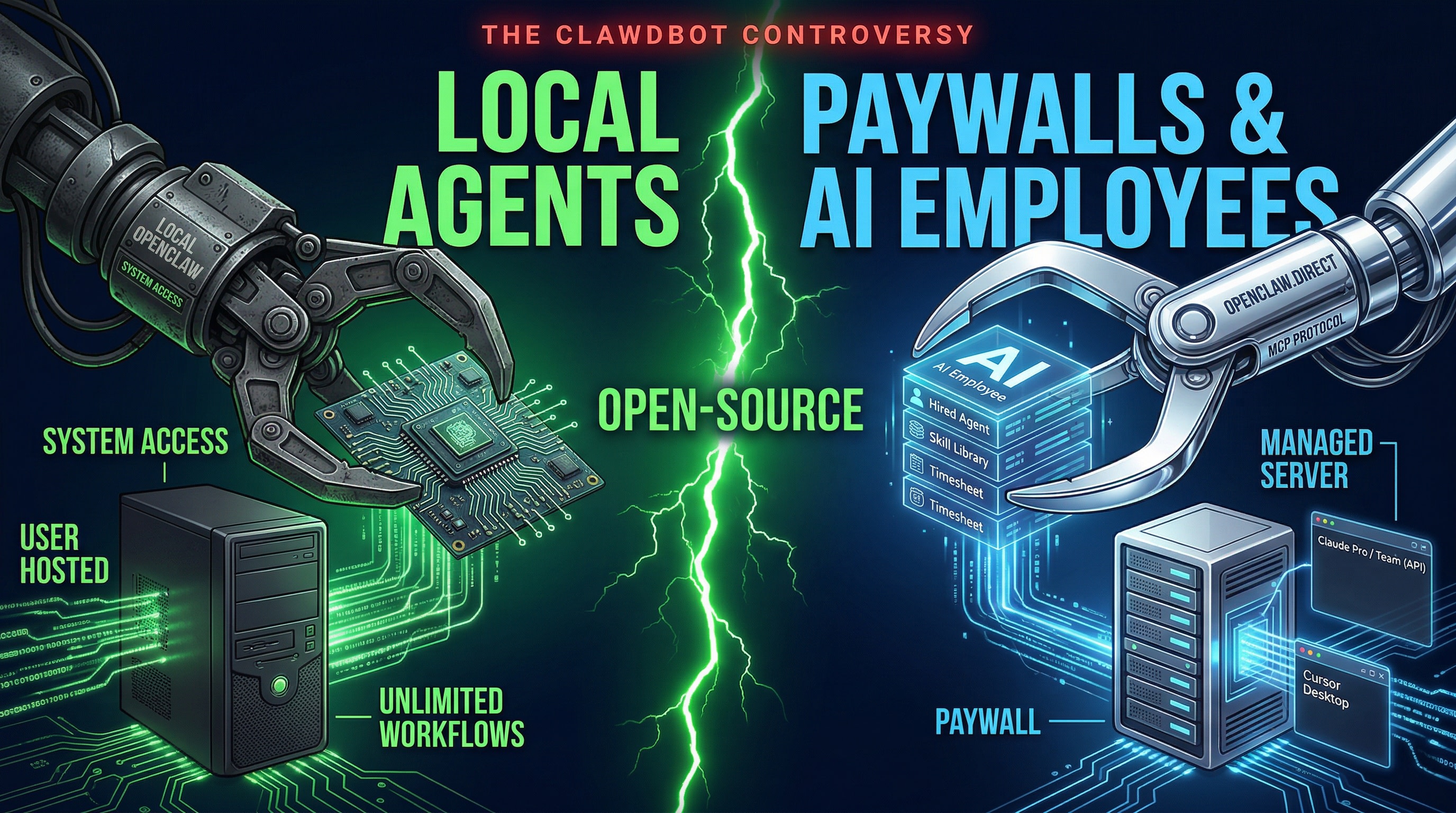
OpenClaw (formerly known as Clawdbot or Moltbot) is a viral, open-source AI agent framework designed to run locally on a user's machine. It allows users to connect large language models (LLMs) like Claude or GPT-4 directly to their local file systems, shell environments, and messaging apps to automate complex, system-level tasks without relying on a centralized cloud workflow.
Why did Anthropic restrict Claude usage for OpenClaw?
Anthropic restricted the use of Claude Pro and Team subscriptions for OpenClaw on April 4, 2026, citing capacity constraints and the excessive usage patterns typical of autonomous agents. The company now requires users to utilize a dedicated "Extra Usage" pay-as-you-go system or the official Anthropic API, effectively ending the era of "free" agentic power for its premium subscribers.
How does OpenClaw.Direct manage 'AI Employees' via MCP?
OpenClaw.Direct is a managed server platform launched on April 6, 2026, that utilizes the Model Context Protocol (MCP) to treat AI agents as "digital employees." Instead of manual configuration, teams can "hire" agents with specialized skills, assign them personalities, and manage their tasks through a unified interface mirrored directly within Claude Desktop, ChatGPT, or Cursor.
Comparison: Local OpenClaw vs. OpenClaw.Direct (Managed)
Feature | Local OpenClaw (Open Source) | OpenClaw.Direct (Managed) |
Hosting | User's local machine | Managed Cloud/Server |
Pricing | Free (Bring your own API key) | Subscription + Usage Fee |
Accessibility | Advanced (Requires local setup) | Beginner (Plug-and-play) |
Control | Full system-level permissions | Sandboxed "Digital Employee" |
Key Use Case | Individual power users / Devs | Enterprise teams & Project Managers |
Is OpenClaw safe to use on a local machine?
While OpenClaw is a powerful automation tool, it carries significant security risks because it requires broad, system-level permissions to execute shell commands and manage files. Users should treat the agent as an autonomous entity with full access to their data and only run it within sandboxed environments or on dedicated machines to prevent accidental data loss or unauthorized system changes.
Can companies use OpenClaw for workforce automation?
Yes, the launch of OpenClaw.Direct signals a move toward using agentic frameworks for legitimate workforce automation. By formalizing AI agents into "employee" roles with defined timesheets, skill libraries, and wellness checks, organizations can scale their digital operations while maintaining the oversight typically reserved for human staff.
Related Insights
What is Agentic AI? Define
## The "Brain with Hands" that Goes Beyond ChatGPT
Read MoreFrom Chatbots to Do-Bots: Welcome to the Age of Agentic AI
## The business world is moving beyond AI that just "talks." The new frontier is AI that can reason, plan, and execute complex workflows autonomously.
Read MoreWhy Your "Custom GPT" Is Failing and How to Actually Build Production AI Agents
## Are you stuck with a great AI demo that can't handle real business logic? It’s time to graduate from "Custom GPTs" to robust AI agent builders like n8n and LangGraph.
Read More