
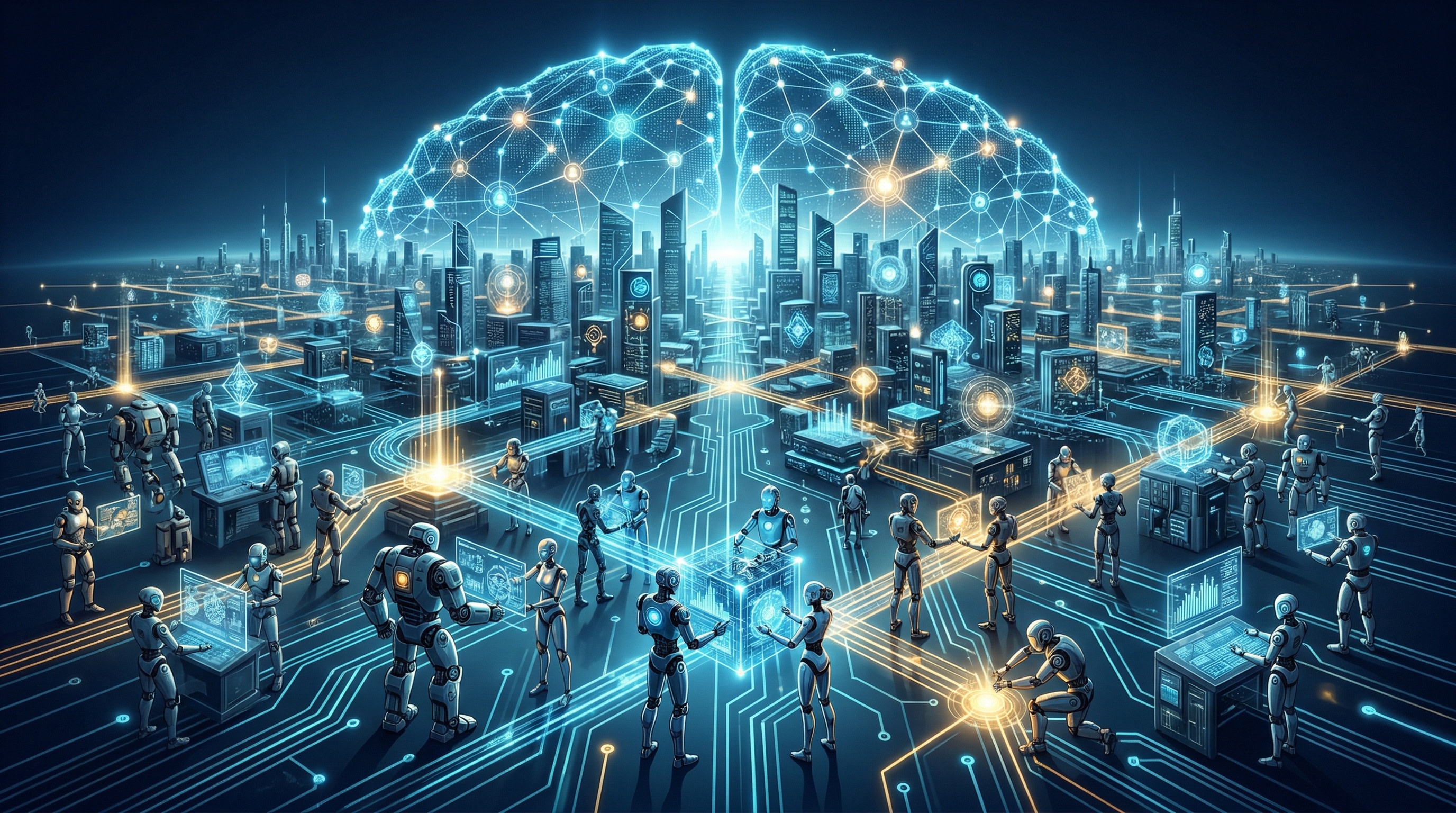
How does the 'Society of Agents' theory differ from the Singularity?
The primary difference lies in centralization versus distribution. While the Singularity predicts a single, monolithic "God-like" AI that eventually transcends human understanding, the Society of Agents theory views intelligence as a relational, high-dimensional property. It suggests that intelligence grows like a city—evolving through the specialized, governed interactions of many distinct agents rather than the emergence of a single meta-mind.
Why is institutional alignment necessary for autonomous agents?
Institutional alignment is critical because traditional reward-based training (e.g., RLHF) is insufficient for managing complex, autonomous systems that interact in large groups. Instead, 2026 research focuses on building "digital protocols" modeled on human markets and governance—effectively embedding checks, balances, and procedural oversight directly into the digital infrastructure to prevent any single concentration of power from becoming unmanageable.
Comparison: Monolithic Singularity vs. Distributed Intelligence Explosion
Key Concept | Monolithic Singularity (Old Theory) | Distributed Intelligence (2026 Reality) |
Growth Model | Self-recursive, single "seed AI" | Combinatorial, social organization |
Analogy | A single super-genius / God | A complex, evolving metropolitan city |
Governance | Impossible (Transcends human control) | Institutional (Protocols & Market rules) |
Integration | Replacement of human cognition | Hybrid "Centaur" human-AI collaboration |
What are the primary drivers of distributed intelligence growth?
The three core pillars driving the 2026 intelligence explosion are:
Agentic Specialization: Building distinct agents for highly specific domains (e.g., legal, coding, research) that collaborate.
Protocol-Based Coordination: Using markets and blockchains to ensure agents trade value and verify data autonomously.
Institutional Memory: Creating shared knowledge bases that allow "swarms" of agents to learn from collective experience rather than individual training.
Can distributed intelligence be controlled?
Distributed intelligence can be effectively managed through "governance as architecture," where conflict and oversight are built into the system design. By ensuring that no single agent holds total control and that separate monitor-agents regulate the performance of task-agents, we can create a self-correcting ecosystem that mirrors the robustness of human democratic institutions.
Related Insights
What is Agentic AI? Define
## The "Brain with Hands" that Goes Beyond ChatGPT
Read MoreFrom Chatbots to Do-Bots: Welcome to the Age of Agentic AI
## The business world is moving beyond AI that just "talks." The new frontier is AI that can reason, plan, and execute complex workflows autonomously.
Read MoreThe OpenClaw Controversy: Agents, Paywalls, and AI Employees
## OpenClaw (formerly known as Clawdbot or Moltbot) is a viral, open-source AI agent framework designed to run locally on a user's machine. It allows users to connect large language models (LLMs) like Claude or GPT-4 directly to their local file systems, shell environments, and messaging apps to automate complex, system-level tasks without relying on a centralized cloud workflow.
Read More