
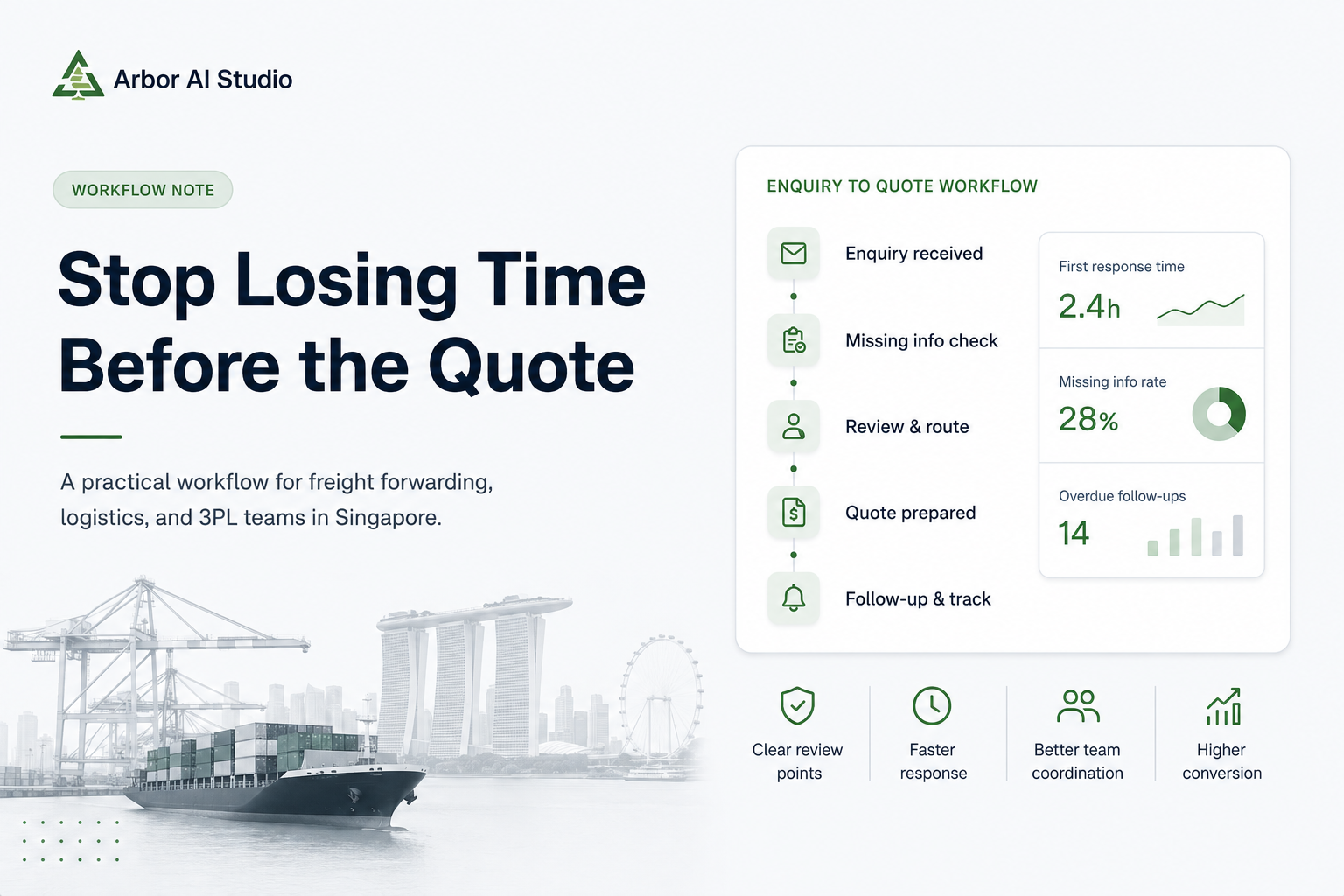
Singapore logistics is running at serious volume.
In 2025, Singapore reached a record 44.66 million TEUs in container throughput and 3.22 billion gross tonnage of vessel arrivals, according to the Maritime and Port Authority of Singapore. In 2024, Singapore Customs issued 9,023,236 TradeNet permits.
That volume means more enquiries, more documents, more customer updates, and more internal follow-ups.
For freight forwarders, logistics providers, and 3PL teams, the pressure is simple: customers want faster replies, but teams cannot keep adding manpower every time the workload grows.
Source: MPA Singapore 2026, Singapore Customs Annual Report 2024
Why this matters now
Singapore businesses are still under cost pressure.
The Singapore Business Federation’s National Business Survey 2025 reported that manpower cost was the top business challenge in 2025, cited by 63% of businesses. Customer demand uncertainty followed at 44%, and rental cost at 40%.
The same release reported that only 4% of businesses saw higher profitability over the past year, while 34% saw a decline.
For logistics companies, this creates a hard operating reality.
The workload is growing. Customers expect faster service. But manpower is expensive, and manual processes are harder to scale.
Source: Singapore Business Federation, National Business Survey 2025
The hidden delay is not always the quote
When a customer sends a freight enquiry, the quote itself may not be the slowest part.
The delay often happens before and after the quote.
A customer may send an enquiry with missing shipment details. The origin may be clear, but the cargo dimensions may be missing. The delivery date may not be confirmed. The Incoterm may not be stated. The cargo type may need clarification.
Then someone has to reply and ask for the missing details.
Another person may need to check rates. Someone else may need to confirm service availability. The enquiry may be copied into a sheet, CRM, shared inbox, or WhatsApp group.
If the customer does not reply, the follow-up depends on someone remembering.
That is where time gets lost.
Not because the team is careless.
Because the workflow depends too much on manual checking, manual routing, and memory-based follow-up.
Why this workflow should be fixed first
Singapore’s logistics sector is already moving toward more digital operations.
IMDA’s Singapore Digital Economy Report 2025 found that 95.1% of SMEs adopted at least one digital area in 2024. The same report also said SME AI adoption increased from 4.2% to 14.5% in 2024.
This does not mean every logistics company needs a complex AI system.
It means more SMEs are becoming open to practical tools that solve real operational work.
IMDA also has a dedicated Logistics Industry Digital Plan for SMEs. It is designed to help logistics companies identify digital solutions, improve operational efficiency, and adopt tools relevant to their stage of growth.
Source: IMDA Singapore Digital Economy Report 2025, IMDA Logistics Industry Digital Plan
The work is already changing
Workforce Singapore’s logistics Jobs Transformation Map says that logistics roles are being affected by automation, robotics, data analytics, and AI.
More importantly, it identifies the exact type of work that can improve.
It says tasks related to scheduling, coordination, and documentation can be significantly improved in efficiency and speed through Industry 4.0 technologies.
That is why enquiry-to-quote is a strong starting point.
It is not only a sales task.
It is a coordination task. It is a documentation task. It is also a customer response task.
Source: WSG/SWDA Jobs Transformation Map: Logistics
What a better enquiry-to-quote workflow looks like
A practical workflow does not need to replace your current tools.
It should sit around the tools your team already uses and make the repeated steps easier to manage.
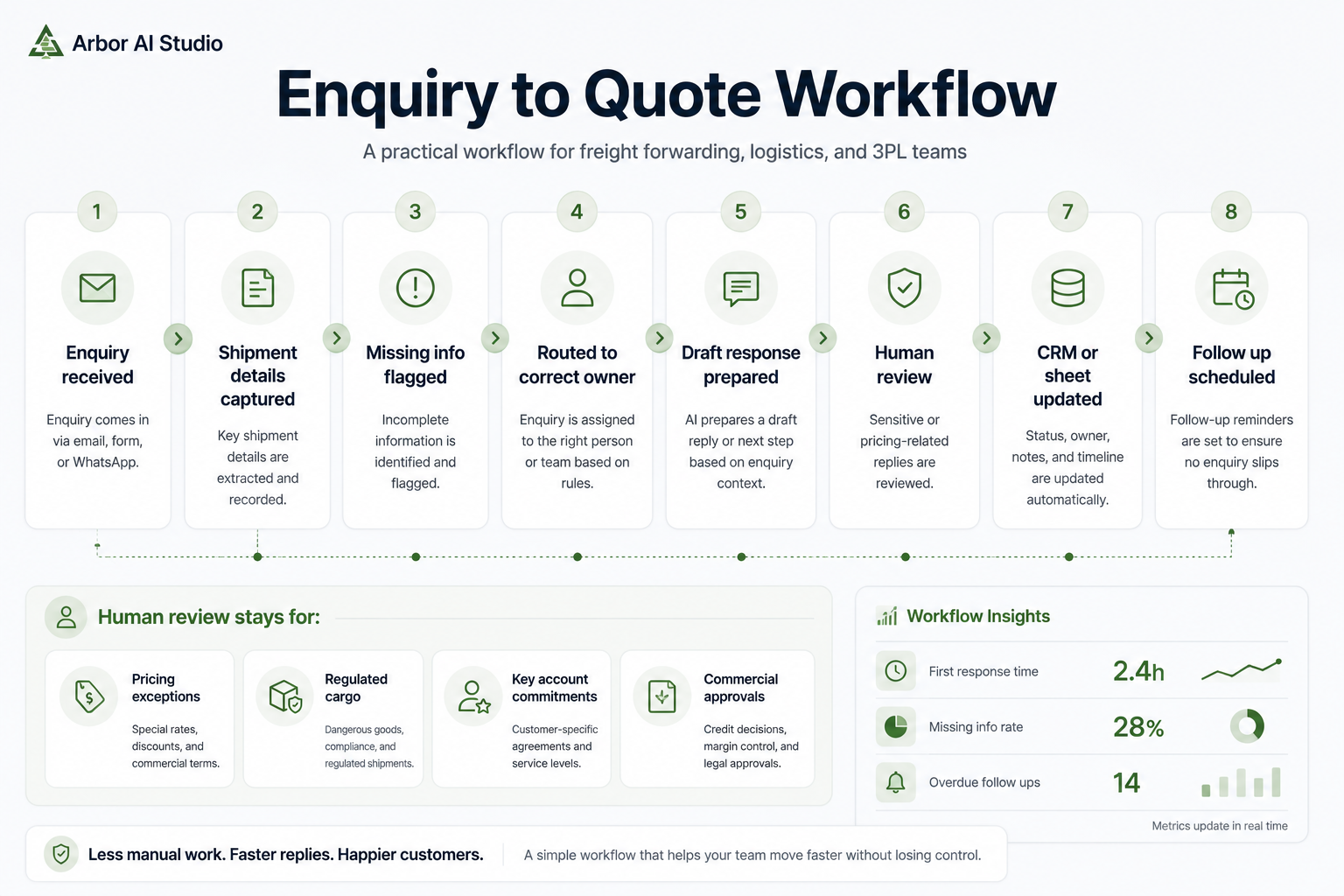
SG logistics workflow
1. Enquiry received
The enquiry comes in through email, website form, WhatsApp, or a shared inbox.
Instead of sitting only in one person’s inbox, it is captured in a structured workflow.
2. Shipment details captured
The key shipment fields are identified.
These may include origin, destination, cargo type, shipment mode, weight, dimensions, volume, ready date, delivery timeline, Incoterm, and service requested.
3. Missing information flagged
If key details are missing, the workflow prepares a short message asking only for the missing items.
This saves time because the team does not need to rewrite the same clarification emails again and again.
4. Routed to the correct owner
The enquiry is assigned to the right person or team.
This can be based on shipment mode, trade lane, service type, customer type, or cargo complexity.
Clear ownership prevents enquiries from getting stuck.
5. Draft response prepared
A first response is drafted.
It may confirm receipt, ask for missing details, or explain the next step. The team can review and edit it before sending.
6. Human review stays in place
Human review should remain for sensitive work.
This includes pricing exceptions, regulated cargo, dangerous goods, key accounts, credit decisions, and commercial approvals.
The goal is not to remove control.
The goal is to reduce repeated manual work while keeping important decisions with the team.
7. CRM or sheet updated
The workflow updates the record automatically.
The team can see who owns the enquiry, what information is missing, whether the quote was sent, and whether follow-up is due.
This reduces manual reporting and gives managers better visibility.
8. Follow-up scheduled
Follow-up should not depend only on memory.
If a customer has not sent missing details, or if a quote was sent but not acknowledged, the workflow can create a reminder.
This makes the process more consistent.
What to measure
Before improving the workflow, measure the current one.
Start with simple numbers:
average first response time
average time from enquiry to quote
percentage of enquiries with missing details
number of manual touches per enquiry
number of overdue follow-ups
number of enquiries without a clear owner
number of quotes sent but not followed up
These numbers help show where time is being lost.
They also make improvement easier to prove.
Real market signal: logistics leaders are already automating repeated work
FedEx reported that it has deployed sorting robots at key APAC facilities, including Singapore. The company said the sorting robot at its Singapore facility can sort up to 1,000 packages per hour and cover up to 100 destinations at the same time.
This is not the same as enquiry-to-quote automation.
But the lesson is relevant.
When a repeated logistics task is structured properly, the team gets faster and reduces manual error.
Source: FedEx, How AI-Powered Sorting Robots Are Redefining Logistics Efficiency
DB Schenker also published a 2024 logistics note explaining how it is testing GPT with OCR for document processing. It said this is being tested across customs files, invoices, master bills of lading, export documents, and claims.
That matters because freight work depends heavily on documents and structured information.
If important details are trapped in emails, PDFs, and attachments, teams spend too much time reading, copying, checking, and updating.
Source: DB Schenker, Unleashing the Power of GPT in Logistics
Final takeaway
Singapore logistics is already operating at high volume.
Port activity is growing. Trade documentation remains heavy. Manpower cost is still a major business challenge. Digital adoption among SMEs is already high. Logistics roles are being redesigned around more technology-enabled work.
The companies that improve first may not be the ones with the biggest systems.
They may be the ones that fix the small workflows slowing teams down every day.
Enquiry-to-quote is one of those workflows.
If your team still handles freight enquiries, missing information checks, quote handoffs, and follow-ups manually, this is a good place to start.
Concerned about RFQ workflow slowing down?
Book a free workflow audit with Arbor AI Studio.
We will map your current process, identify the manual gaps, and show where automation can help without changing the tools your team already uses.
Related Insights
Agentic AI vs Generative AI
## From Creative Sparks to Operational Engines
Read MoreFrom Chatbots to Do-Bots: Welcome to the Age of Agentic AI
## The business world is moving beyond AI that just "talks." The new frontier is AI that can reason, plan, and execute complex workflows autonomously.
Read MoreWhy Your "Custom GPT" Is Failing and How to Actually Build Production AI Agents
## Are you stuck with a great AI demo that can't handle real business logic? It’s time to graduate from "Custom GPTs" to robust AI agent builders like n8n and LangGraph.
Read More