
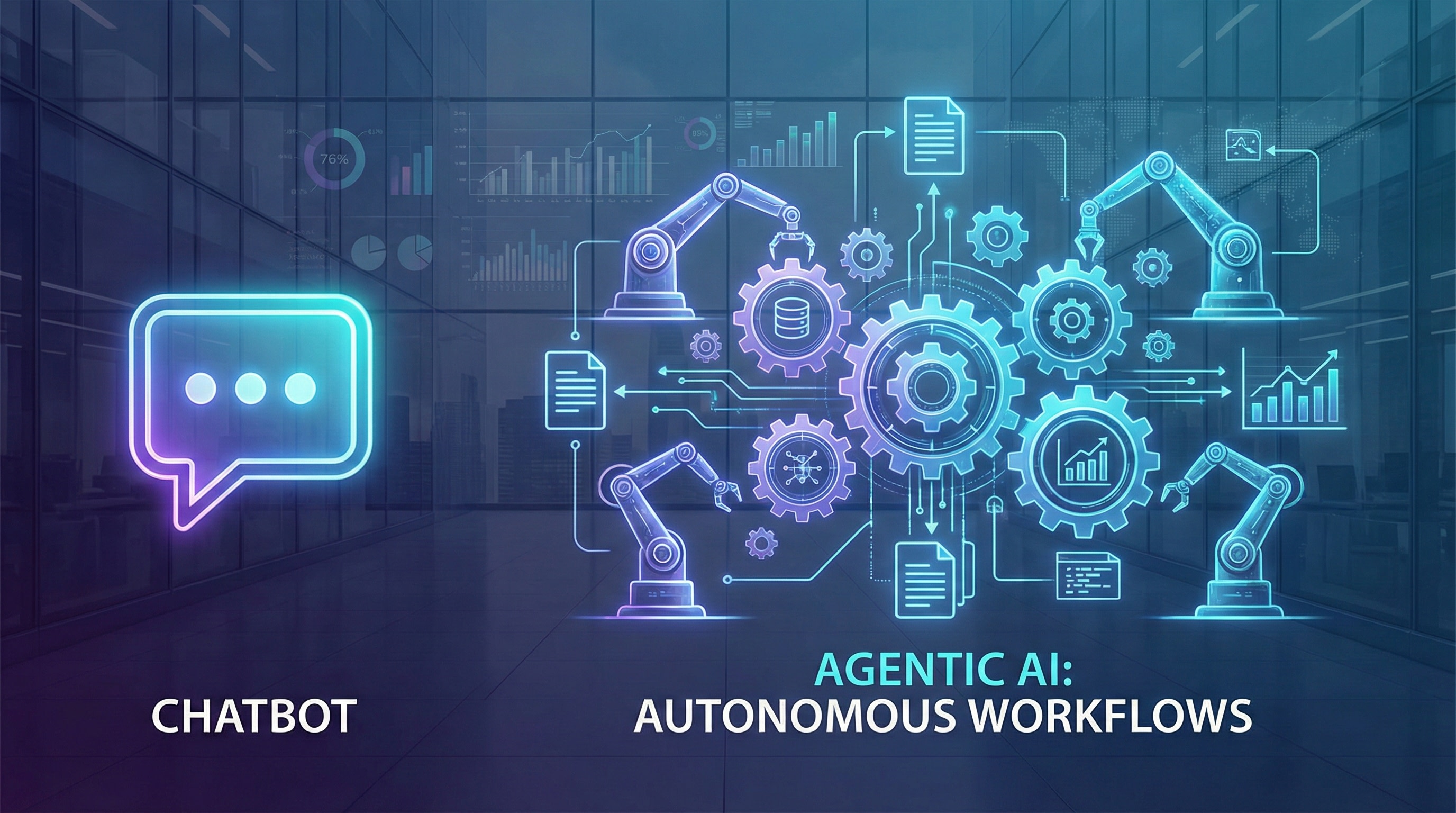
If 2023 was the year we learned to talk to AI, and 2024 was the year we integrated it into our applications, recent global trends confirm we have officially entered a new era: The Age of Agentic AI.
What is the difference between a Chatbot and a Do-Bot?
Do-Bots or Agentic AI systems, differ from traditional chatbots because they don't just talk—they take action. While a chatbot waits for your next prompt to generate text, a "Do-Bot" (Agentic AI) uses its reasoning capabilities to plan a multi-step workflow and execute it using external software, APIs, and web browsers. It isn't just answering a question; it's completing a job.
How does Agentic AI solve the "Workslop" problem?
Agentic AI solves the "workslop" issue—the flood of low-quality AI content that humans have to clean up—by introducing rigorous self-correction and multi-step validation. Instead of a single-shot generation that might be full of errors, an agentic workflow involves drafting, testing, reviewing, and refining. This reduces the friction of "human-in-the-loop" oversight because the agent acts as its own first editor.
Why is the business world shifting toward "Agency" right now?
The shift toward agency is happening now because of three critical market pressures that have come to a head in early 2026:
The ROI Mandate: Boards are tired of "AI experiments" and are demanding tangible bottom-line results that only end-to-end automation can provide.
The Open Source Explosion: Models like DeepSeek have democratized the "reasoning" power needed to build agents, meaning you no longer need a massive proprietary budget to compete.
The Efficiency Gap: Winning businesses have realized that writing faster isn't enough; they need to act faster to stay ahead of the market.
What are the real-world impacts of Agentic AI in 2026?
The impact of agentic workflows is already visible across high-stakes industries:
Finance: Junior Banker agents are condensing ten-hour pitch deck cycles into 30-minute automated sprints.
Customer Experience: We've moved from chatbots that summarize "how to change a flight" to actionable agents that actually access the booking system and change it for you.
Software Development: Multi-agent ecosystems are now the default, where one AI writes code, another reviews it for security, and a third handles the documentation simultaneously.
Can your business prepare for the Age of Agentic AI?
Yes, the best way to prepare is to audit your existing workflows for "task sequences" rather than just "creative sparks." Any process that requires a human to copy-paste data between three different apps is a prime candidate for an agentic pilot. The goal for 2026 is to move your team from being the "engine" of the work to being the "pilot" of the agents.
Related Insights
What is Agentic AI? Define
## The "Brain with Hands" that Goes Beyond ChatGPT
Read MoreAgentic AI vs Generative AI
## From Creative Sparks to Operational Engines
Read MoreWhy Mythos and Muse AI are Trending in Business
## The landscape of enterprise AI shifted dramatically this month with the emergence of two powerhouse technologies: Mythos AI and Muse AI. While one focuses on the "brain" of business automation, the other revolutionizes how companies engage with customers through multimedia and social commerce.
Read More